

Porcelain veneers represent one of the most transformative procedures in modern cosmetic dentistry. According to recent industry data, the global cosmetic dentistry market is projected to grow significantly, with veneers remaining a top choice for smile makeovers. No-prep veneers, often referred to as minimal-prep or Lumineers, have gained immense popularity for their conservative approach. However, determining whether they are "better" than traditional veneers depends entirely on your specific dental anatomy and aesthetic goals. At Smiles by Dr. P, we evaluate each patient's unique needs to recommend the optimal path to a stunning smile.
What Are No-Prep Veneers?
No-prep veneers are ultra-thin shells of medical-grade porcelain that are bonded to the front surface of your teeth. Unlike traditional veneers, which require the removal of a layer of enamel to ensure proper fit and bonding, no-prep veneers are designed to be placed directly over the natural tooth structure with little to no reduction. This technique is often associated with brands like Lumineers, though the term "no-prep" generally describes the conservative clinical approach rather than a specific brand.
The primary advantage of this method is the preservation of your natural enamel. Because the enamel is not removed, the procedure is often reversible. If you decide later that you do not wish to keep the veneers, your teeth can be returned to their original state. This reversibility is a significant factor for patients who are hesitant about committing to permanent cosmetic changes. For more details on the general process, you can review our Process of Veneers page.
Traditional vs. Minimal-Prep: The Core Differences
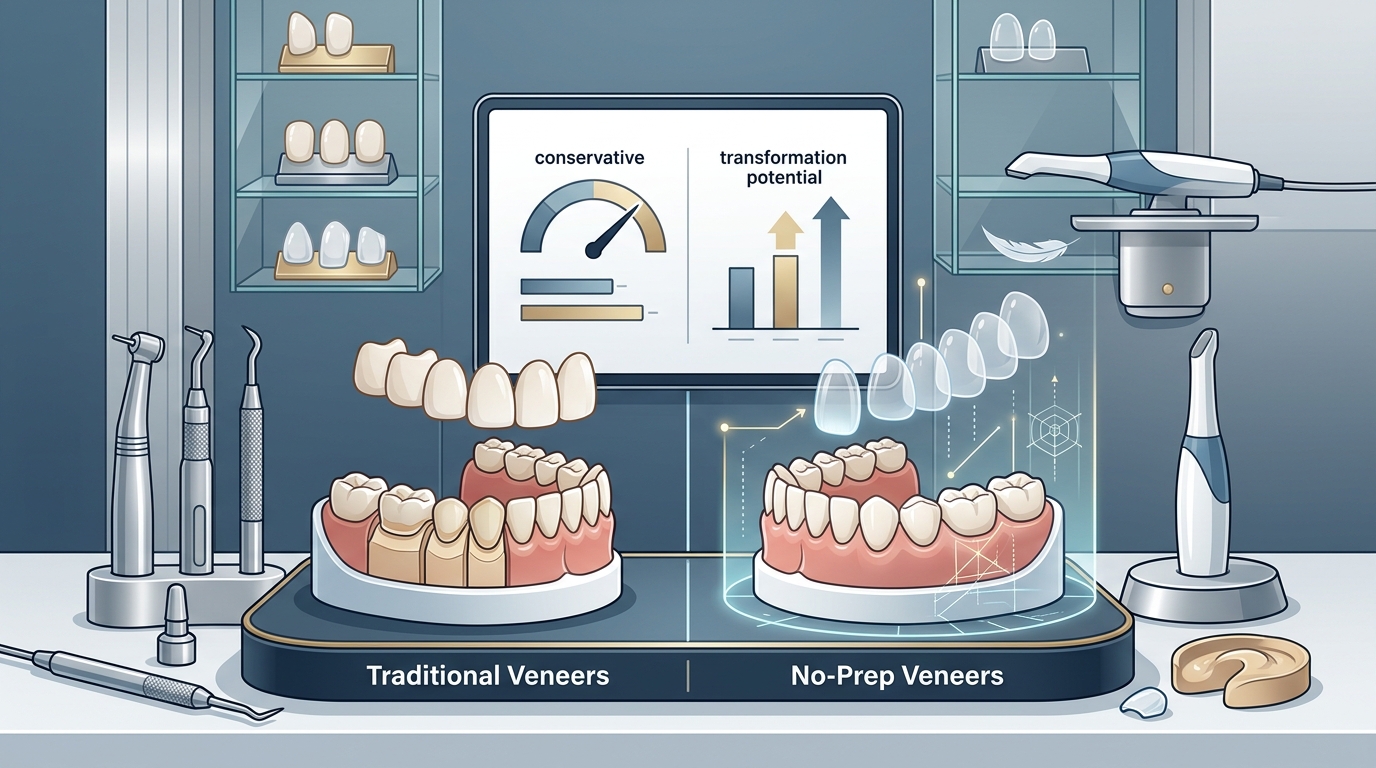
Understanding the mechanical differences between these two types of veneers is crucial for making an informed decision. The distinction lies primarily in the amount of tooth reduction required and the resulting thickness of the final restoration.
Tooth Reduction Requirements
Traditional veneers typically require the removal of 0.3 to 0.5 millimeters of enamel. This step is necessary to prevent the veneers from looking bulky or protruding from the lips. By shaving down the tooth, the dentist ensures that the final restoration sits flush with the surrounding teeth. In contrast, no-prep veneers are often less than 0.2 millimeters thick. This extreme thinness allows them to be placed without any enamel removal, preserving the natural integrity of the tooth.
Aesthetic Outcomes and Opacity
Because no-prep veneers are so thin, they can sometimes appear more opaque or less natural than traditional veneers, especially if the underlying tooth is dark or discolored. Traditional veneers allow for more customization in terms of color and translucency because the dentist can mask underlying imperfections more effectively with a slightly thicker layer of porcelain. If you are dealing with severe discoloration, such as tetracycline stains, traditional veneers or veneers for tetracycline stain correction might yield more natural results.
Pros and Cons of No-Prep Veneers
While no-prep veneers offer a conservative alternative, they are not a one-size-fits-all solution. It is essential to weigh the benefits against the potential limitations.
Advantages
- Enamel Preservation: The most significant benefit is the retention of natural tooth structure. This is critical for long-term dental health.
- Reversibility: Since no enamel is removed, the procedure is technically reversible. You are not permanently altering your teeth.
- Minimal Sensitivity: Patients often experience little to no post-operative sensitivity because the dentin (the sensitive inner layer of the tooth) is not exposed.
- Faster Treatment Time: The process can be quicker because there is no waiting period for temporary veneers or healing time for gum tissue.
Disadvantages
- Limited Correction: No-prep veneers cannot significantly change the shape, size, or alignment of teeth. They are best suited for minor cosmetic enhancements.
- Bulkiness Risk: If the teeth are already crowded or protruding, adding a layer of porcelain can make the smile look wider or "duck-like." In such cases, clear aligners might be recommended first to create space.
- Color Matching Challenges: As mentioned, masking dark teeth is difficult with ultra-thin porcelain. You may need to whiten your natural teeth first to ensure a seamless blend.
Who Is a Candidate for No-Prep Veneers?
Not everyone is eligible for no-prep veneers. Ideal candidates typically have healthy teeth with minor cosmetic flaws. You might be a good candidate if you have:
- Minor gaps between teeth (diastema).
- Chipped or worn edges on your front teeth.
- Mild discoloration that responds well to whitening.
- Teeth that are already straight and properly aligned.
Conversely, if you have severe crowding, significant misalignment, or large gaps, traditional veneers or orthodontic treatment may be necessary. For patients with veneers for closing gaps, the decision between no-prep and traditional often depends on the size of the gap. Large gaps require the veneers to be wider than the natural teeth, which can look unnatural if no-prep veneers are used without prior alignment.
The Process: No-Prep vs. Traditional
The clinical workflow for both procedures shares similarities but diverges in the preparation phase. Understanding this timeline helps manage expectations.
No-Prep Veneer Workflow
- Consultation and Imaging: Dr. Patel takes digital scans and photos to design your custom smile.
- Minimal or No Preparation: Little to no enamel is removed. The tooth surface is etched to create a bonding surface.
- Impression: A digital scan or physical impression is taken and sent to the lab.
- Placement: Once the veneers are ready, they are bonded to your teeth. Because no temporary veneers are needed, you go home with your final smile immediately.
Traditional Veneer Workflow
- Tooth Reduction: Enamel is shaved down to create space for the veneer.
- Temporary Veneers: You wear temporary veneers for 1-2 weeks while the permanent ones are fabricated.
- Permanent Placement: The temporaries are removed, and the custom porcelain veneers are bonded.
For a deeper dive into the specific steps involved in a smile makeover, explore our Veneers FAQ section.
Cost and Durability Considerations
Both no-prep and traditional veneers are premium cosmetic treatments. The cost can vary based on the number of units and the complexity of the case. Generally, the pricing for both types is comparable, though no-prep veneers might sometimes be slightly less expensive due to the reduced chair time. However, the long-term value depends on durability and maintenance.
Veneers, regardless of type, typically last between 10 and 15 years with proper care. They are not permanent, but they are also not easily replaced. Aftercare of veneers is critical to their longevity. This includes brushing twice a day, flossing daily, and wearing an occlusal guard if you grind your teeth. Avoiding hard foods like ice or hard candy is also essential to prevent chipping.
Comparison Summary
| Feature | No-Prep Veneers | Traditional Veneers |
|---|---|---|
| Enamel Removal | None or Minimal | 0.3 - 0.5 mm |
| Reversibility | Reversible | Permanent |
| Best For | Minor flaws, straight teeth | Major corrections, discoloration |
| Thickness | Ultra-thin (<0.2mm) | Standard (0.5mm+) |
| Temporaries | Not Required | Required |
Key Takeaways
- No-prep veneers preserve natural enamel, making them a reversible option for minor cosmetic fixes.
- Traditional veneers are better for significant shape, size, or color corrections due to their ability to mask underlying issues.
- Dr. Chirag Patel at Smiles by Dr. P specializes in both types, ensuring a personalized recommendation for each patient.
- Proper aftercare, including regular dental visits and good hygiene, is vital for the longevity of any veneer type.
- No-prep veneers may not be suitable for patients with crowded teeth or severe discoloration without prior treatment.
- The cost of both options is comparable, with the decision largely driven by clinical suitability rather than price.
- A consultation is the only way to determine if your teeth are healthy enough for a no-prep approach.
Frequently Asked Questions
Are no-prep veneers as strong as traditional veneers?
Yes, no-prep veneers are made from high-strength dental porcelain. While they are thinner, the material is engineered to withstand normal biting forces. However, patients who grind their teeth may need a protective night guard to prevent damage.
Can no-prep veneers fix crooked teeth?
No-prep veneers can create the illusion of straighter teeth by altering the shape and width of the front surface. However, they cannot physically move the tooth root. For significantly crooked teeth, clear aligners or traditional veneers that require tooth reduction are more effective.
How long do no-prep veneers last?
With proper care, no-prep veneers can last 10 to 15 years or longer. The longevity depends on your oral hygiene, diet, and whether you avoid habits like nail-biting or chewing on pens.
Do no-prep veneers look natural?
When placed on teeth that are already relatively straight and light-colored, no-prep veneers can look very natural. However, if the underlying tooth is dark, the thin porcelain may not mask it completely, potentially resulting in a less natural appearance.
Is the procedure painful?
No-prep veneers typically involve little to no discomfort because no drilling or anesthesia is required. Traditional veneers may cause temporary sensitivity after enamel removal, but this usually subsides quickly.
Can I whiten my teeth after getting no-prep veneers?
Porcelain veneers cannot be whitened. If you whiten your natural teeth after the veneers are placed, your natural teeth may become lighter than the veneers, creating a mismatch. It is best to complete any whitening treatments before getting veneers.
How much do no-prep veneers cost in Beverly Hills?
The cost varies based on the number of veneers and the complexity of the case. For a detailed pricing breakdown, please visit our Cost of Porcelain Veneers page or contact our office directly.
Schedule Your Consultation
Deciding between no-prep and traditional veneers is a personal journey that requires expert guidance. At Smiles by Dr. P, we combine advanced technology with a patient-centered approach to help you achieve your dream smile. Whether you are interested in veneers before and after results or need a comprehensive smile makeover, our team is here to support you.
Located in Beverly Hills, we serve patients from Los Angeles and beyond. Contact us today to schedule your consultation and take the first step toward a confident, radiant smile.