

No-prep veneers are ultra-thin porcelain shells bonded to teeth with minimal or zero enamel removal. They are not universally better than traditional veneers. The right choice depends on your specific dental anatomy, aesthetic goals, and bite dynamics. This guide breaks down the clinical differences, longevity, and cost factors to help you decide.
Minimal Tooth Preparation
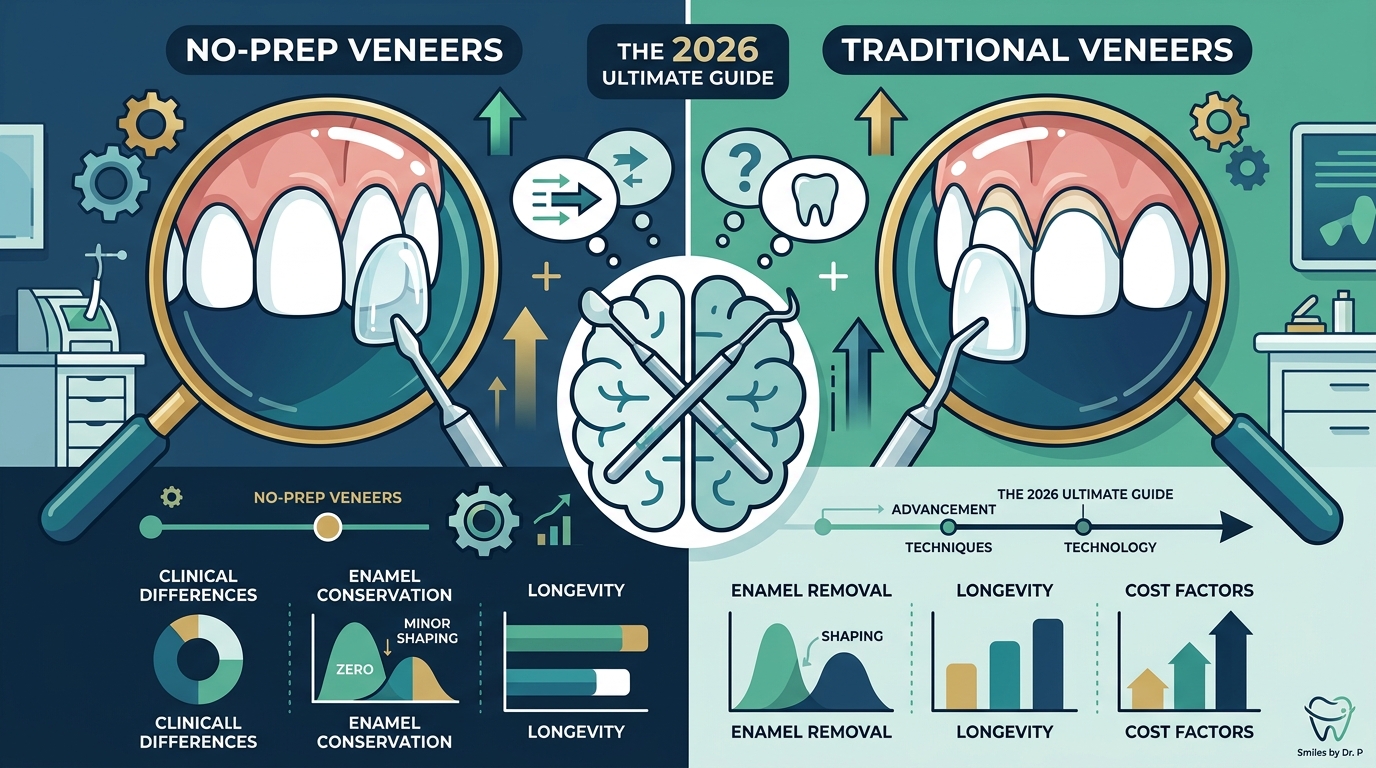
Traditional porcelain veneers require the removal of 0.5 to 0.7 millimeters of enamel. This preparation creates space for the ceramic shell to fit flush against the tooth. No-prep veneers, also known as prepless veneers, require 0 to 0.3 millimeters of enamel removal. This conservative approach preserves the structural integrity of the natural tooth.
At Smiles by Dr. P, Dr. Chirag Patel utilizes a minimally invasive protocol. The goal is to achieve a natural smile without sacrificing healthy tooth structure. This method is ideal for patients with healthy enamel who want to correct minor cosmetic issues.
The Clinical Difference
Traditional prep involves grinding down the front surface of the tooth. No-prep involves bonding directly to the existing enamel surface. The bonding agent used in no-prep cases must be highly adhesive to ensure longevity without the mechanical retention provided by tooth reduction.
Reversibility and Enamel Preservation
Traditional veneers are considered irreversible. Once enamel is removed, it does not grow back. If a traditional veneer fails, the tooth must be restored with another crown or veneer. No-prep veneers are often described as reversible. Because little to no enamel is removed, the tooth can be restored to its original state if the veneer is removed.
This reversibility is a significant advantage for younger patients. It allows for future treatment options if dental needs change over time. Preserving enamel is a core principle of modern cosmetic dentistry.
Why Preservation Matters
Enamel is the hardest substance in the human body. Removing it permanently alters the tooth's structure. By preserving enamel, no-prep veneers maintain the tooth's natural strength and resistance to decay. This is particularly important for patients who may need orthodontic treatment or other dental work in the future.
Aesthetic Limitations of No-Prep Veneers
No-prep veneers have specific aesthetic limitations. They are best suited for minor corrections. They work well for closing small gaps, correcting slight discoloration, and improving the shape of teeth. They are not ideal for severe malocclusion or significant tooth misalignment.
When No-Prep Falls Short
No-prep veneers may not provide the desired aesthetic result for patients with severe crowding or large gaps. The thinness of the material limits the amount of tooth structure that can be covered. In these cases, traditional veneers or orthodontic treatment may be necessary.
Durability Comparison
Both no-prep and traditional veneers are durable when properly maintained. Traditional veneers typically last 10 to 20 years. No-prep veneers have a similar lifespan, but their longevity depends heavily on the bonding process. The bond between the veneer and the tooth must be strong enough to withstand daily chewing forces.
At Smiles by Dr. P, patients are provided with detailed aftercare instructions. This includes the use of night guards to protect veneers from grinding and clenching. Proper maintenance is critical for the longevity of any type of veneer.
Maintenance Requirements
Both types of veneers require regular dental checkups and professional cleanings. Patients should avoid biting hard objects like ice or hard candy. Good oral hygiene practices, including brushing and flossing, are essential to prevent decay around the veneer margins.
Traditional Veneer Advantages
Traditional veneers offer several advantages over no-prep options. They provide greater control over the final aesthetic result. The dentist can shape the veneer to correct significant cosmetic issues. This makes them a better choice for patients with more complex smile concerns.
Cost Considerations
The cost of veneers varies based on the complexity of the case. Traditional veneers may be slightly more expensive due to the additional preparation required. However, the long-term value of a well-crafted veneer is significant. Patients should discuss cost and financing options with their dentist during the consultation.
Key Takeaways
- No-prep veneers require minimal or zero enamel removal, preserving natural tooth structure.
- Traditional veneers require 0.5 to 0.7 mm of enamel removal for better retention.
- No-prep veneers are often reversible, offering future treatment flexibility.
- Traditional veneers provide greater aesthetic control for complex smile corrections.
- Both types of veneers last 10 to 20 years with proper care.
- Night guards are essential for protecting veneers from grinding and clenching.
- A consultation with a cosmetic dentist is necessary to determine the best option.
- Preserving enamel is a key benefit of no-prep veneers for younger patients.
Frequently Asked Questions
Are no-prep veneers really reversible?
Yes, no-prep veneers are considered reversible because little to no enamel is removed. If the veneer is removed, the tooth can be restored to its original state. Traditional veneers are irreversible because enamel is permanently removed.
How long do no-prep veneers last?
No-prep veneers typically last 10 to 20 years. Their longevity depends on the quality of the bonding process and proper maintenance. Regular dental checkups and the use of night guards can extend their lifespan.
Can no-prep veneers fix severe crowding?
No, no-prep veneers are not ideal for severe crowding. They are best suited for minor cosmetic corrections. For significant misalignment, traditional veneers or orthodontic treatment may be necessary.
Do no-prep veneers stain easily?
No, porcelain veneers are highly resistant to staining. Both no-prep and traditional veneers maintain their color over time. Good oral hygiene practices help preserve the appearance of the veneers.
Is the no-prep procedure painful?
The no-prep procedure is generally painless. Because little to no enamel is removed, local anesthesia may not be required. Some patients may experience mild sensitivity, but this is usually temporary.
How much do no-prep veneers cost?
The cost of no-prep veneers varies based on the number of teeth treated and the complexity of the case. Patients should consult with their dentist for a personalized estimate. Financing options are often available to make the treatment more affordable.
Who is a good candidate for no-prep veneers?
Good candidates for no-prep veneers have healthy teeth and gums with minor cosmetic concerns. They should not have severe decay or significant bite issues. A consultation with a cosmetic dentist will determine if you are a suitable candidate.
Do I need a night guard with no-prep veneers?
Yes, a night guard is recommended for all veneer patients. Grinding and clenching can exert significant pressure on the veneers, potentially causing them to chip or fall off. A custom-fitted night guard protects your investment.